“Jesus Himself indeed shone as the sun, signifying that He is ‘the true light that enlightens every man come into the world.’ What the sun is to the eyes of the flesh, so He is to the eyes of the heart” (Saint Augustine, Sermon 28 on the New Testament).
Like so many episodes in the life of our Lord, His Transfiguration at Mount Sinai receives disproportionately little attention in the Church’s worship compared to its paramount importance in the economy of salvation – if for no other reason than the finite number of Sundays in a single year. In the Revised Common Lectionary tradition, the Transfiguration of Christ is typically commemorated in the Gospel reading for the Last Sunday after the Epiphany, sitting as an exclamation point at the end of the season and a guidepost as we follow Him down the mountain into the desert for Lent. The only other day dedicated to this moment is the Feast of the Transfiguration, which falls every year on August 6th, and not always on a Sunday.
We owe it to ourselves, then, out of obedience to our Lord and for our own spiritual well-being, to linger in the radiant glow of the Transfigured Christ with the Apostles Peter, James, and John more often. The Transfiguration is no mere spectacle – it is the inescapable dawn of the Son’s manifest power and glory; it is a proclamation of Divine authority which demands our response.
God from God, Light from Light
To borrow from Saint Augustine, Jesus “shone as the sun” on the Mount of His Transfiguration. The manifestation of the glory of Jesus takes the form of brilliant light. As we read from Saint Luke’s account in this year’s lectionary cycle (Year C):
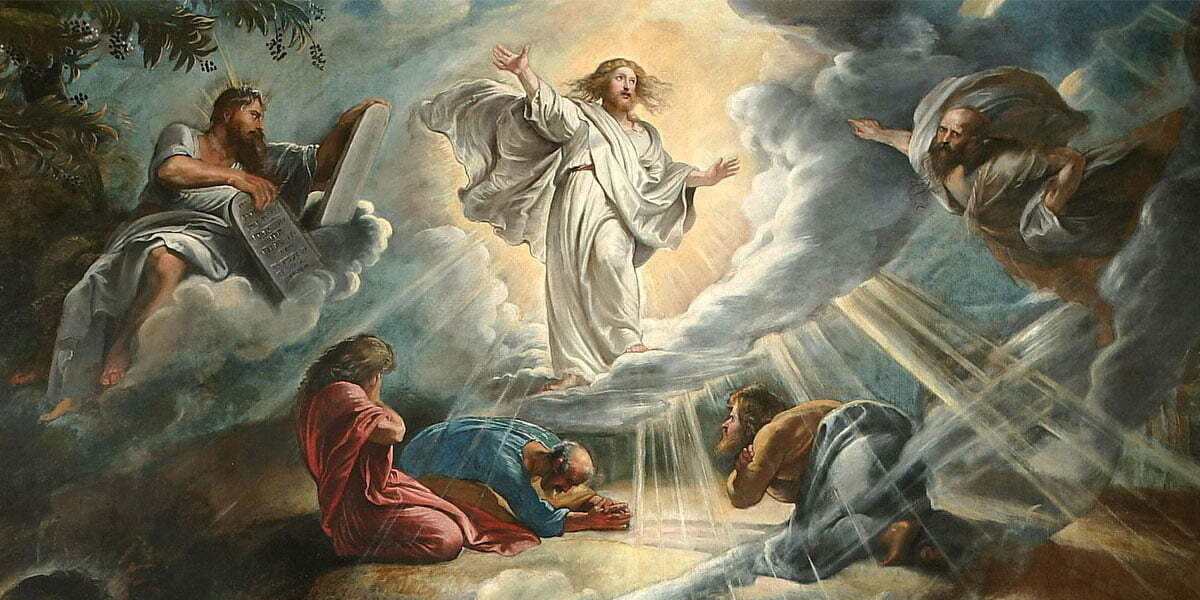
“About eight days after Peter had acknowledged Jesus as The Christ of God, Jesus took with him Peter and John and James and went up on the mountain to pray. And as he was praying, the appearance of his face was altered, and his clothing became dazzling white” (Luke 9:28-29).
The “dazzling white” described by Luke, taken literally, means “as bright as a flash of lightning.” Jesus was not reflecting light from an external source; He was illuminated from within.
I am reminded of the Nicene Creed, where we pray:
We believe in one Lord, Jesus Christ,
the only Son of God,
eternally begotten of the Father,
God from God, Light from Light,
true God from true God,
begotten, not made,
of one Being with the Father.
Our true confession of faith in Jesus Christ affirms that He is truly the Son of God, and not just a prophet or a wise teacher from the first century. Jesus, the Son of God, is co-equal and co-eternal with the Father, perfectly united in one Being with Him (the ancient Creed uses the word “homoousios,” meaning, “of the same substance”). Jesus is not another god, nor was He created by God, nor is He inferior to God the Father in any way.
The affirmation “God from God, Light from Light” thus reminds us that Jesus’ transformation before Peter, James, and John was a glimpse of his own eternal glory, which is the glory of God the Father. Jesus shines from within because He is Light, and He is Light because He is one with the Father and of one Being with the Father.
When Moses came down from Mount Sinai with the stone tablets after seeing the LORD’s back from behind the cleft of a rock, the skin of his face shone. Moses shone as a reflection of God’s glory; Jesus did not reflect the Father’s glory but shone it directly, because their glory is one and the same. Moses was not permitted to see the face of God, lest he die; Peter, James, and John personally witnessed the face of God through His Son Jesus Christ, though they did not realize it at the time. Likewise, when we seek to deepen our relationship with Jesus and are conformed to His image, the eyes of our hearts are opened to see the face of the LORD through His Son.
Not only was Jesus’ face altered, but his clothes became “dazzling white.” This image prefigures our heavenly future through faith in Him: the garments worn by God’s elect in the high vault of heaven are white as snow. Those garments, worn by all who enter the Wedding Feast of the Lamb, are white precisely because they have been washed in the blood of the Lamb (see Revelation 7:14).
Christ’s Transfiguration is our assurance of these glorious realities.
Arrival of the Messianic Age
What we learn from the Transfiguration goes beyond Jesus’ change in appearance. After his physical transformation, Moses and Elijah appear next to Jesus and speak with him:
“And behold, two men were talking with him, Moses and Elijah, who appeared in glory and spoke of his departure, which he was about to accomplish at Jerusalem” (Luke 9:30).
The appearance of these two with Jesus clearly demonstrates that He is the perfect fulfillment of the Law (represented by Moses) and the Prophets (represented by Elijah), the hope for salvation of God’s people. Luke writes that Moses and Elijah spoke with Jesus about his coming “departure” at Jerusalem, translated as “his exodus” in Greek. As Pope Benedict XVI explains in his book, Jesus of Nazareth:
“Their topic of conversation is the Cross, but understood in an inclusive sense as Jesus’ Exodus, which had to take place in Jerusalem. Jesus’ Cross is an Exodus: a departure from this life, a passage through the “Red Sea” of the Passion, and a transition into glory – a glory, however, that forever bears the mark of Jesus’ wounds” (Ratzinger, 311).
This conversation reinforces the fact that the Law and the Prophets both point to the hope of Israel, fulfilled in the person of Jesus, who leads an Exodus to eternal freedom and renewal – a hope secured by His own suffering as Servant of God and Son of Man. We commemorate this new Exodus in the liturgy for the Great Vigil of Easter, remembering God’s faithful deliverance of the Israelites through the Red Sea, and renewing our hope in the One who will deliver us into glory.
At this point in time, the three disciples awaken and are overcome with fear at what they see. Then Peter, still in a daze from his slumber, suggests to Jesus something that may appear nonsensical at first:
“Peter said to Jesus, ‘Master, it is good that we are here. Let us make three tents, one for you and one for Moses and one for Elijah’—not knowing what he said.” (Luke 9:33).
Some scholars date the timing of Jesus’ Transfiguration to the last day of the Jewish Feast of Tabernacles – a remembrance of God’s past provision for the Israelites as they wandered the desert, dwelling in tents, and an anticipation of the tents where the righteous would dwell in the age to come. It is possible, then, that Peter saw the Transfiguration of Jesus as the beginning of this messianic age, prompting him to build such tents as were predicted by the Feast of Tabernacles.
The Word did indeed become flesh and pitch his tent among us (see John 1:14) in the person of Jesus Christ, but the Feast of Tabernacles was not yet fulfilled on the Mount of Transfiguration. The messianic age had begun, but Jesus still needed to redeem the tabernacle of humanity. As Benedict wrote poignantly:
“It is only as they go down from the mountain that Peter has to learn once again that the messianic age is first and foremost the age of the Cross and that the Transfiguration – the experience of becoming light from and with the Lord – requires us to be burned by the light of the Passion and so transformed” (315).
Proclamation of Divine Authority
The Transfiguration event culminated in a final display of Jesus’ power and authority, concluding with a simple command:
“As he was saying these things, a cloud came and overshadowed them, and they were afraid as they entered the cloud. And a voice came out of the cloud, saying, ‘This is my Son, my Chosen One; listen to him!’ And when the voice had spoken, Jesus was found alone” (Luke 9:34-36).
The cloud that overcame Jesus and the Apostles is once again reminiscent of the Israelites’ desert wandering. This cloud is the same theophany (a visible manifestation of God’s presence) as the shekinah cloud which led God’s people through the desert by day (Exodus 13:21) and hovered over the Tent of Meeting (Exodus 40:34). As Benedict points out, “The cloud hovering over the Tent of Meeting indicated that God was present. Jesus is the holy tent above whom the cloud of God’s presence now stands and spreads out to ‘overshadow’ the others as well” (316).
Together with the Gospel reading for the First Sunday after the Epiphany (which commemorates the Baptism of Jesus), Luke’s account of the Transfiguration bookends this season of the Church year with repeat proclamations from the LORD: “This is my Son, my Chosen One” (Luke 9:35; see also Luke 3:22). Here God adds an essential command: “Listen to him!”
When Moses encountered the LORD atop Mount Sinai, he descended with the Torah, God’s word of law, which the Israelites were called to obey. Now, atop the mountain the three Apostles encounter the LORD in the person of His Son, who is the living Torah, and they descend the mountain with Him, whom they are called to obey. God calls us to do the same.
The Transfiguration of Christ is a proclamation of His divine authority. When Jesus shone like the sun, the Apostles witnessed the coming glory of God’s Kingdom in power (see Mark 9:1). When the LORD thus proclaims, “This is my Son, my Chosen One; listen to him” (Luke 9:35), He makes an absolute truth claim about Christ’s heavenly authority.
No Room for Indifference
This proclamation presents us with a binary choice. Just as we must choose whether to submit to earthly authorities, we must also choose whether we will submit to Christ’s divine authority. Here the Transfiguration demands a response: submit or disobey. There is no middle ground – one cannot witness Christ’s true majesty and remain indifferent.
In an age where moral absolutism is anathema, it is popular to play the fence about any assertion which calls into question matters of eternal significance – claims which deny a person’s “right” to do whatever he pleases without moral judgement (even demanding acceptance from others) so long as he is not thought to be harming others; claims which also contradict our collective reassurance that all faiths are “a path to God” and it does not matter so much what one believes in the end. By this worldview it is far more fashionable, even intelligent, to claim indifference and uncertainty: “Why make such a big deal about God? We really can’t know for certain. Everyone is just trying their best. Who am I to judge?”
Of course, when it comes to following earthly authorities, fence-sitting does not work as a get-out-of-jail-free card. The police officer who pulls you over for speeding will not listen to your arguments about the speed limit being relative – the number on the sign applies whether you choose to believe in it or not. The IRS still expects you to pay taxes even if you claim to be a good person just trying your best – claiming ignorance or indifference to the tax code does not work as an exemption.
Likewise, as revealed in glory on the Mount of Transfiguration, Jesus Christ’s absolute divine authority as the Son of God is not contingent upon our approval. The Kingdom of God has arrived with power. Either Jesus is God from God, light from light, or we have utterly deceived ourselves. There is no middle ground. When Peter, James, and John descended the mountain after Jesus, they began their initiation into the full reality of God’s Kingdom which we enjoy today as God’s New Covenant people. The Apostles followed a King who did not wield His power over them but exercised that very power through His willing sacrifice on the Cross. We must also descend the mountain and follow Jesus there. If we do, then Christ’s manifest power in our lives will shine a light that cuts through the darkness of a world that is anti-truth – for though we dwell “in a land of deep darkness” (see Isaiah 9:2), we have seen a great light, and that light will never be extinguished.